Software startups fail for a hundred reasons. Hardware startups fail for a narrower set, and the most common one is a founder who built a business plan on software assumptions. The product works, the demand is real, the team is capable, and the company runs out of money somewhere between a working prototype and a manufacturable product, in a gap nobody warned them about.
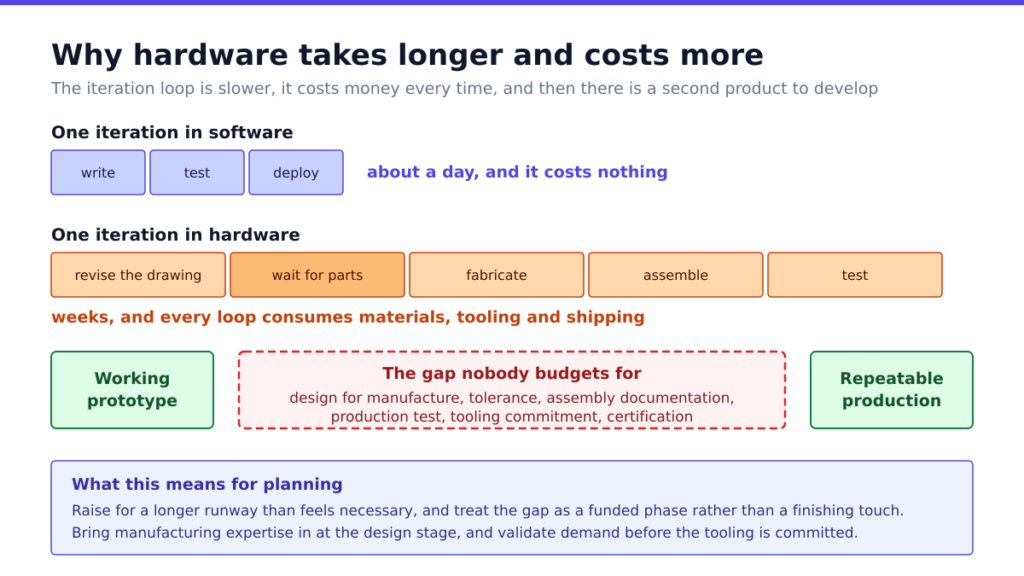
The iteration loop is slower and it costs money every time
In software, a change is written, tested and deployed in a day. In hardware, a design change means revising a drawing, ordering parts with lead times, machining or printing a part, assembling it, and testing it. Each loop takes weeks and each loop costs real money in tooling, materials and shipping.
That difference compounds. A product needing twenty design iterations consumes twenty cycles of weeks rather than twenty cycles of days, and the timeline stretches accordingly. Founders accustomed to rapid iteration consistently underestimate this, and the schedules they present to investors reflect the underestimate.
The practical response is to separate what must be learned physically from what can be learned otherwise. Simulation, cardboard mock ups, off the shelf modules and testing subsystems independently all buy learning without consuming a full build cycle. The expensive iterations should be reserved for questions that genuinely require a complete working unit.
Prototype to production is a second product development
This is the gap that surprises people most. A prototype proves the concept works. It does not prove the thing can be made repeatably, by someone else, at a cost that permits a business, passing the tests it must pass.
Design for manufacture means revisiting nearly every decision with different criteria. Parts that were machined because machining was quick must often be redesigned for moulding or casting, which have their own geometric rules. Hand assembly steps that a skilled engineer performs intuitively must become documented operations a trained operator can repeat. Tolerances that happened to work on one unit must be specified so that any combination of parts within tolerance still functions, which is a statistical question rather than a geometric one.
Test and calibration must be designed as well, because every unit leaving a factory needs verification, and a test procedure taking thirty minutes per unit is a cost structure of its own. These considerations mirror the process stability requirements described in our note on how small manufacturers decide what to automate first, and for the same reason, which is that a process not yet stable cannot be scaled.
Tooling, the cash flow problem that has no equivalent in software
Injection moulds, die cast tools, stamping dies and custom fixtures are paid for before a single unit is sold, and they are specific to a design. Change the design after the tool is cut and the tool is modified at cost or scrapped entirely.
This creates a genuine dilemma. Commit to tooling early and risk expensive rework when the design changes, which it will. Delay tooling and accept high unit costs from low volume processes for longer, which limits how competitively the product can be priced during exactly the period when market feedback matters most.
There is no clean answer. The usual approach is bridge tooling, using soft tools or low volume processes to serve early demand while the design settles, accepting a higher unit cost in exchange for retaining the ability to change. The important thing is to make that choice deliberately rather than discovering the trade off after committing.
Supply chain, lead times and minimum quantities
A bill of materials with two hundred lines has two hundred ways to be late. Semiconductor lead times have at times extended to a year or more, and a product held up by one component is held up entirely regardless of how available the other hundred and ninety nine are.
Minimum order quantities compound it. A supplier willing to sell a hundred units for prototyping may require ten thousand for production pricing, which means working capital tied up in inventory before revenue arrives. Scaling therefore requires cash not only for production but for the inventory that production sits on, and that working capital requirement grows with success rather than shrinking.
Second sourcing critical components and designing for substitutability where possible is the main defence, and it is design work that must happen early, because qualifying an alternative part after a product is certified means repeating the certification.
Certification, which is a schedule item not a formality
Depending on what the product does and where it is sold, it may require electrical safety approval, electromagnetic compatibility testing, radio approval, and in regulated sectors a great deal more. Testing takes weeks, costs meaningful sums, and a failure means a design change followed by retesting.
The error that causes real damage is treating certification as a final step. A product designed without regard to electromagnetic compatibility frequently fails, and the fixes, shielding, filtering, layout changes, are far cheaper when anticipated than when retrofitted. Certification requirements belong in the specification at the outset.
What this means for planning
Hardware businesses need more capital, deployed over longer periods, with a larger share committed before revenue, than software businesses of comparable ambition. That is a structural feature of making physical things, not a sign of mismanagement, and the companies that succeed are generally the ones that planned for it.
The practical implications are consistent. Raise for a longer runway than feels necessary. Treat prototype to production as a distinct funded phase rather than a finishing touch. Bring manufacturing expertise in early, whether as a hire, an adviser or a contract manufacturer engaged at the design stage. And validate demand before the expensive commitments, because the cost of discovering a market problem after tooling is in a different category from discovering it before. The cost discipline involved is the same as that set out in our note on the real payback period on a factory automation project. General background is summarised in the overview of design for manufacturability.
Frequently asked questions
Why is hardware iteration so much slower?
Because each change requires drawings, component lead times, fabrication, assembly and testing. Loops take weeks rather than days and cost money every time.
What is the gap between prototype and production?
A second development effort. The design must be revisited for manufacturability, repeatability, tolerance, assembly documentation and production testing, none of which a prototype demonstrates.
When should tooling be committed?
There is no clean answer. Bridge tooling or low volume processes serve early demand at higher unit cost while the design settles, preserving the ability to change.
Why does working capital grow with success?
Because production pricing usually requires minimum order quantities, so inventory must be funded ahead of revenue, and the requirement increases as volumes rise.
When should certification be considered?
At specification, not at the end. Electromagnetic compatibility and safety requirements are far cheaper to design for than to retrofit after a failed test.