Every small manufacturer that starts thinking seriously about automation faces the same trap. The most visible problem looks like the obvious place to start, and the most visible problem is usually the worst candidate. The bottleneck everybody complains about is often complicated, variable and tangled up with customer specific requirements, which is precisely why it resisted improvement for years. Meanwhile the boring, repetitive, high volume task that nobody mentions would pay for an automation cell in eighteen months.
Find out where the time actually goes
Before any technology question, answer a measurement question. Which operations consume the most labour hours per month, and which generate the most rework. Not which feel worst, which actually consume the hours.
In most small plants nobody knows. Production is tracked at order level, not operation level, so the conversation runs on impressions. A fortnight of deliberate observation, timing operations and logging where work waits, usually produces at least one genuine surprise. Often the most expensive activity is not making anything. It is moving material, looking for tooling, waiting for a machine to finish, or inspecting and reworking.
This matters because automating a process that is not the constraint improves nothing overall. The output of a line is set by its slowest step, so making a non constraining step faster simply builds inventory in front of the real bottleneck.
What makes a task a good first candidate
Repetition without variation
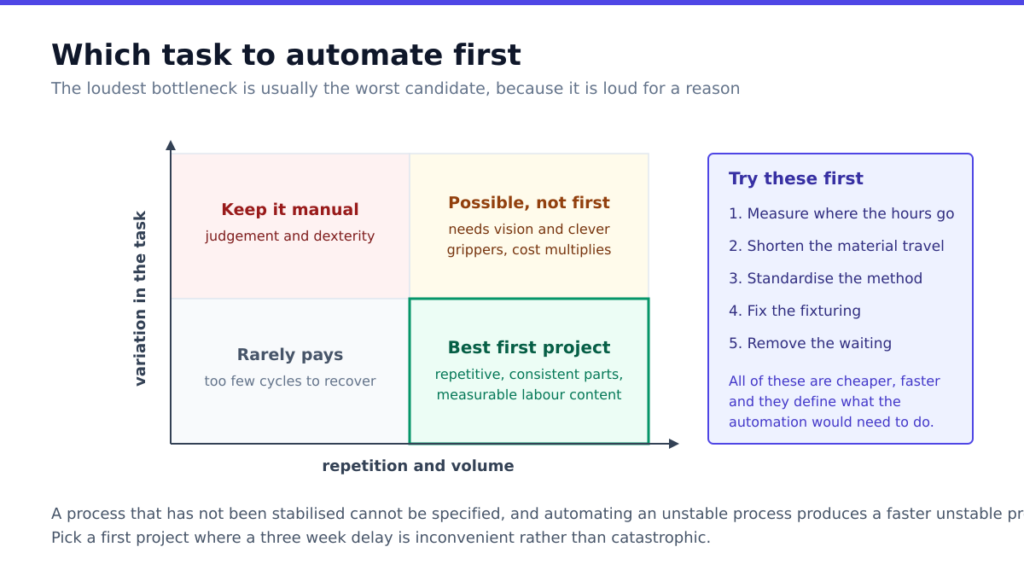
Robots and fixed automation are excellent at doing the same thing many times and poor at judgement. A task performed thousands of times a month on identical parts is a strong candidate. The same task on parts that vary in shape, finish or presentation requires sensing and decision making that multiplies cost and risk.
Consistent part presentation
This is the single most underestimated requirement. If parts arrive in a bin in random orientation, the automation needs vision, sophisticated grippers and tolerance for failures. If parts can be presented in a fixture, a tray or a known orientation, the problem becomes dramatically simpler. Spending effort upstream to present parts consistently frequently costs less than the vision system it avoids.
Measurable, labour intensive and unpleasant
A task with a clear cycle time and a clear labour content can be justified on numbers. A task people dislike doing, whether because it is dirty, heavy, noisy or monotonous, carries a second benefit, since the staff you redeploy are usually glad to be redeployed, which matters enormously for how the project is received on the floor.
Quality consequences
Where manual variation causes scrap or rework, the savings include material and warranty exposure as well as labour, and those are often larger than the labour saving alone.
What makes a bad first candidate
High variety and low volume, where changeover dominates. Tasks requiring dexterity, tactile judgement or visual inspection of subtle defects. Processes that are not yet stable, because automating an unreliable process produces a faster unreliable process. Anything where the specification changes frequently. And the plant’s single most critical operation, because the first project should not be the one that stops shipments when commissioning takes longer than planned.
That last point deserves emphasis. The first automation project is partly a learning exercise. Choose something where a three week delay is inconvenient rather than catastrophic.
Order of operations, cheapest first
Automation is the most expensive answer to a flow problem and should usually not be the first one tried. Before buying equipment, exhaust the cheaper interventions. Reorganise the layout so material travels less. Standardise the process so it is performed the same way by everyone. Fix the tooling and fixturing. Remove the waiting. Simplify the product where engineering allows.
These steps cost little, deliver quickly, and they also reveal what the process really requires. A process that has been stabilised and documented is a process that can be automated. One that has not is a moving target, and a specification written against a moving target produces an automation cell that works beautifully for the version of the job that existed when the order was placed.
Starting small, deliberately
The most reliable pattern for a first project is a single cell doing one well understood task, installed alongside existing manual capability rather than replacing it outright. That arrangement provides a fallback, allows comparison, and lets the team build competence before anything critical depends on the new equipment.
It also exposes the requirement nobody budgets for, which is capability. Automated equipment needs people who can set it, adjust it, diagnose it and repair it. If no one in the building can do that, the equipment will spend a meaningful share of its life waiting for a visit from the supplier. Budgeting training and, where necessary, recruitment alongside the capital is the difference between an asset and an ornament, which is the subject of our note on hiring and keeping skilled technical staff.
The financial case deserves the same scepticism, and the common errors are set out in our piece on the real payback period on a factory automation project. General background on the technology options is summarised in the overview of industrial robots.
Frequently asked questions
Should we automate our biggest bottleneck first?
Usually not. The visible bottleneck is often complex and variable, which is why it resisted improvement. A simpler high volume task frequently pays back faster and teaches the organisation more.
What is the most common reason a first project disappoints?
Automating a process that was never stabilised. An unreliable process automated becomes a faster unreliable process, and the specification drifts because the job itself was still changing.
Why does part presentation matter so much?
Because randomly oriented parts require vision and sophisticated gripping, which multiplies cost and failure modes. Presenting parts consistently upstream is often cheaper than the sensing it avoids.
Do we need to hire new people?
You need someone able to set, adjust and diagnose the equipment, whether trained internally or recruited. Without that capability, uptime depends on supplier availability.
What should be done before buying anything?
Measure where labour hours and rework actually occur, then exhaust layout changes, process standardisation, fixturing improvements and product simplification. These are cheaper, faster and they define what automation would need to do.