Energy efficiency is the dullest item on any improvement list and frequently the one with the shortest payback. It attracts no enthusiasm because nothing visible changes, there is no new machine to show visitors, and the benefit arrives as a slightly smaller bill rather than as a capability. It is also, in most small factories, available in quantities that would embarrass a capital project.
Compressed air, first and by a wide margin
Compressed air is the most expensive utility in a typical plant per unit of useful work delivered, because generating it is inefficient and most of the input energy becomes heat. It is also treated as free by everyone who uses it, since the cost appears on a single meter at the compressor rather than at the point of use.
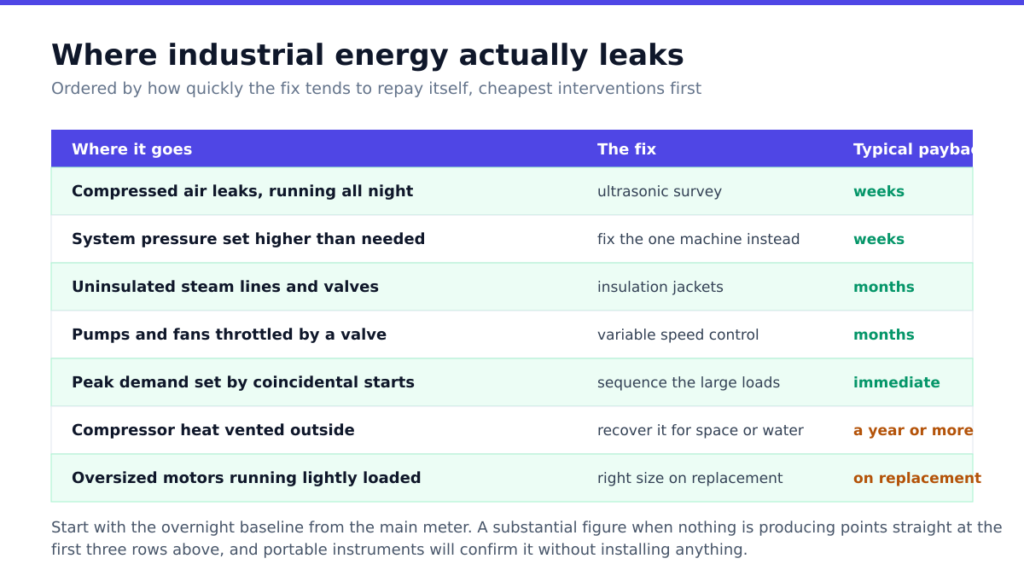
Leakage is the dominant waste. In plants that have never conducted a survey, the share of compressor output escaping through leaks is commonly substantial, and because leaks run continuously including nights and weekends, they consume energy for far more hours than production does. Finding them is straightforward with an ultrasonic detector, since the frequencies involved are above human hearing but easy for an instrument to locate.
Beyond leaks, pressure setting matters. Every additional unit of system pressure costs energy across the whole plant, and systems are routinely run higher than necessary because one machine needs it. The cheaper answer is usually to fix that one machine’s supply rather than raise pressure everywhere. Open blowing for cleaning or cooling is another common waste, where engineered nozzles or a blower replace a hose at a fraction of the energy.
Motors and drives
Electric motors account for the large majority of industrial electricity consumption, so efficiency improvements there scale. Two interventions dominate.
The first is matching the drive to the duty. Centrifugal fans and pumps have power consumption rising roughly with the cube of speed, which means a modest reduction in speed produces a large reduction in power. Where flow is currently controlled by throttling a valve or a damper, replacing that with speed control is among the best returns available in any plant, because throttling wastes energy deliberately in order to restrict flow.
The second is sizing. Motors are routinely oversized, often because a replacement was selected from what was available rather than from the load. An oversized motor operating at a small fraction of its rating runs at poor efficiency and poor power factor, and the problem compounds through every replacement cycle unless somebody measures the actual load.
Efficiency classes also matter on replacement. The incremental cost of a higher efficiency class is recovered quickly on a motor that runs continuously, and barely at all on one that runs occasionally, which is the right way to decide rather than applying a blanket policy.
Heat, recovered or simply not lost
Any process rejecting heat is a candidate. Compressors turn almost all their input energy into heat, and that heat can warm a workshop or preheat water instead of being vented. Ovens, furnaces and dryers lose heat through inadequate insulation, open doors and unnecessary purge cycles, and insulation on steam lines and valves is among the cheapest interventions in existence with some of the shortest paybacks.
Compressed air and steam systems share a characteristic worth noting. Both are generated centrally, distributed widely and wasted locally, which makes the loss invisible to whoever causes it.
Lighting, controls and the building
Lighting is usually already addressed, since the economics of modern fixtures are overwhelming, but controls are frequently not. Occupancy sensing in stores, plant rooms and intermittently used areas, and daylight linking where there are roof lights, cost little and run automatically.
The wider building deserves attention too, because heating a space with a large open loading door is a losing proposition, and in many plants the largest single energy flow is not the process at all but the heating and ventilation.
Demand charges, which are not about consumption
Commercial electricity tariffs frequently charge for peak demand as well as total energy, based on the highest short interval in the billing period. That means a single coincidental start of several large loads can set a charge that persists for the whole month.
Managing it requires knowing when the peak occurs, which requires interval data rather than a monthly total. Sequencing large loads so they do not start together, shifting discretionary loads out of the peak window and in some cases automatic load shedding can reduce that charge appreciably without reducing output at all, which makes it a genuinely free saving.
Finding the opportunities rather than guessing
The sequence that works is measurement first. Interval data from the main meter shows the plant’s load shape, including the overnight and weekend baseline, which is frequently the most revealing single number available. A substantial baseline when nothing is producing means something is running that need not be, and that something is usually compressed air leakage, ventilation or heating.
Sub metering major loads separates the picture into actionable parts. Portable instruments, clamp meters, data loggers, ultrasonic leak detectors and thermal cameras, answer most initial questions without permanent installation, in the manner described in our note on Industry 4.0 sensors, what they actually measure.
Then address the cheap items first. Leaks, pressure settings, insulation, controls and scheduling before capital projects. The returns on those are typically measured in months, which is a different category of decision from the automation investments discussed in our piece on the real payback period on a factory automation project. General background is summarised in the overview of efficient energy use.
Frequently asked questions
Where should a small plant look first?
Compressed air leaks, because the waste runs continuously including nights and weekends and an ultrasonic detector finds leaks quickly without any installation.
Why is throttling a pump wasteful?
Because it restricts flow by deliberately destroying energy. Speed control reduces power roughly with the cube of speed, which is why variable speed on centrifugal loads returns so well.
Is a higher efficiency motor always worth it?
Only where the motor runs enough hours to recover the premium. Decide per application rather than by blanket policy.
What does the overnight baseline tell you?
How much energy the plant consumes when producing nothing. A substantial figure points to leakage, ventilation or heating running unnecessarily.
Can demand charges be reduced without cutting output?
Often yes, by sequencing large loads so they do not start together and shifting discretionary loads out of the peak window. This requires interval data to identify when the peak occurs.