Automation proposals arrive with a payback figure attached, and the figure is almost always calculated the same way. Take the labour cost the equipment displaces, divide the capital cost by it, and report the result in years. That calculation is not wrong so much as incomplete, and the items it omits tend to fall on the same side of the ledger.
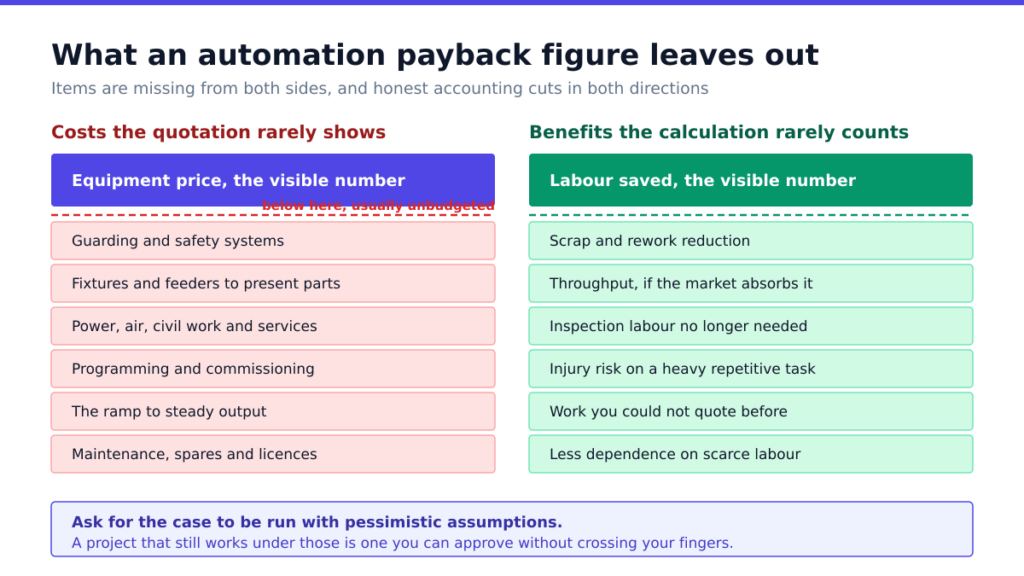
What the simple calculation leaves out
Integration is not a line item on the quotation
The robot, the cell, the machine is the visible cost. Around it sit several others. Guarding and safety systems to satisfy risk assessment. Conveyors, feeders or fixtures to present parts consistently. Electrical supply and compressed air brought to the location. Civil work, because a machine may need a slab or a reinforced floor. Programming and commissioning. Factory acceptance and site acceptance testing. Depending on the project, these together can approach or exceed the equipment price.
The learning curve is real and unbudgeted
New equipment does not reach rated output on the day it is handed over. There is a ramp, during which output is below both the new target and sometimes the old manual rate, while operators learn, programs are tuned and the inevitable early faults are found. Treating the project as instantaneously productive overstates the first year badly.
Ongoing costs continue
Maintenance, spare parts, consumable tooling, software licences and periodic recalibration all recur. Electricity for the cell is usually minor and not always zero, and compressed air, if the cell uses it heavily, is considerably more expensive than people assume.
Labour rarely disappears entirely
The saving is usually a reduction rather than an elimination. Someone still loads, unloads, inspects, intervenes on faults and changes over between products. A proposal claiming two operators eliminated frequently turns out to eliminate one and a half, and the half matters at these margins.
What the simple calculation also leaves out on the other side
Honest accounting cuts both ways, and the benefits omitted are often larger than the costs omitted.
Scrap and rework reduction is the big one. Where manual variation causes defects, consistent automated processing reduces material waste, inspection labour and warranty exposure, and in some operations this exceeds the labour saving outright.
Throughput increase is frequently undervalued because it is harder to calculate. If the cell relieves a genuine constraint and the market will absorb more output, the benefit is additional contribution margin rather than merely avoided cost, and contribution margin on incremental volume is usually a much larger number than an hourly rate.
Then there are the benefits that resist quantification but are not imaginary. Reduced injury risk on a heavy or repetitive task, with its insurance and lost time implications. Capacity to take work that could not previously be quoted competitively. Reduced dependence on finding and keeping people for a job nobody wants, which in a tight labour market is a strategic rather than a financial consideration, as discussed in our note on hiring and keeping skilled technical staff.
Beyond simple payback
Simple payback ignores the cost of money and everything after the break even point, which makes it a poor tool for comparing projects with different lifetimes. For a decision of any size, discounted measures are worth the effort.
Net present value discounts each year’s cash flow and states the result as a single figure in today’s money, which allows two dissimilar projects to be compared directly. Internal rate of return expresses the same analysis as a percentage that can be set against the company’s cost of capital. Both require an assumption about equipment life, and that assumption deserves scrutiny, because automation is frequently obsoleted by a product change rather than worn out.
That last point is the strongest argument for modest, flexible first projects. A cell that can be reconfigured for a different part retains value through a product transition. A purpose built line for one part number is worth very little once that part is discontinued, however well it was engineered.
A format worth insisting on
Ask any proposal to present total installed cost including integration, safety, services and civil work, not equipment price. Ask for a ramp assumption, showing month by month output to steady state. Ask for the labour saving expressed as a change in headcount with the residual tasks described. Ask for scrap and rework effects stated separately from labour. Ask for annual recurring costs. Ask for the assumed equipment life and the basis for it. And ask for the calculation run with a pessimistic case, because a project that survives a pessimistic case is a project you can approve without crossing your fingers.
A proposal that cannot produce that is not necessarily dishonest. It is frequently just a quotation for equipment, presented as a business case, and the gap between those two things is where disappointment lives. Choosing a project that fits this discipline is the subject of our note on how small manufacturers decide what to automate first. General background is summarised in the overview of the payback period.
Frequently asked questions
What is usually missing from an automation payback figure?
Integration, safety systems, part presentation hardware, services, commissioning, the production ramp and recurring costs. Also, often, the scrap reduction and throughput gain on the benefit side.
Does automation eliminate the labour entirely?
Rarely. Loading, unloading, inspection, fault intervention and changeover usually remain, so the saving is a reduction rather than an elimination.
Why is simple payback a weak measure?
It ignores the cost of money and everything beyond the break even point, so it cannot compare projects with different lifetimes. Net present value or internal rate of return are better for decisions of any size.
How long should equipment life be assumed?
Long enough to be realistic but short enough to account for product change, which obsoletes automation more often than wear does. Flexible cells hold value through a product transition, dedicated lines do not.
What single question improves a proposal most?
Asking for the case to be run with pessimistic assumptions. A project that still works under those is one you can approve with confidence.