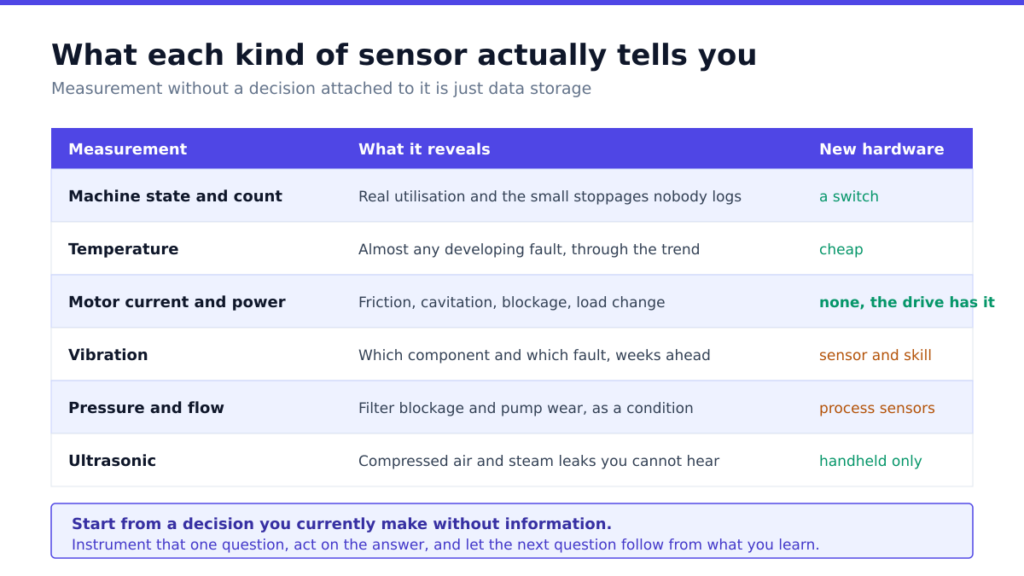
Industry 4.0 arrives in most factories as a sales conversation about sensors and dashboards, and it frequently ends as a dashboard nobody opens. The technology is not the problem. The problem is that measurement without a decision attached to it is just data storage, and the easiest way to avoid that outcome is to understand what each kind of sensor actually tells you and what question it answers.
Vibration, the workhorse of machine condition
An accelerometer mounted on a bearing housing measures how the machine moves. Analysed in the frequency domain, that movement separates into components attributable to specific causes. Imbalance appears at rotational frequency. Misalignment produces characteristic harmonics. Bearing defects generate high frequency signatures at frequencies calculable from the bearing geometry. Gear problems appear at tooth meshing frequencies.
This specificity is what makes vibration monitoring valuable. It does not merely say that a machine is unwell. It frequently says which component and which fault, weeks or months before failure. The limitation is that interpretation requires either expertise or software trained on the specific machine, and raw spectra handed to someone untrained are not actionable.
Temperature, cheap and surprisingly informative
Almost every mechanical and electrical fault eventually produces heat. A loose electrical connection heats. A failing bearing heats. A blocked filter makes everything downstream of it heat. Measuring temperature is inexpensive, and the useful signal is almost always the trend rather than the absolute value.
A motor running five degrees warmer than it did six months ago under the same load has a developing problem, even if it remains far below any alarm threshold. Thermal imaging extends this across whole panels and machines, and its particular strength is finding electrical faults that no mechanical sensor would detect.
Current and power, the sensor already installed
This is the measurement most often overlooked, because it needs no new hardware. Variable frequency drives and motor protection relays already measure current, torque estimate, power and operating hours, and most can report them over a network.
Motor current signature analysis infers mechanical condition from electrical behaviour. A conveyor drawing more current for the same product flow has increased friction somewhere. A pump whose current has fallen may be cavitating or running against a closed valve. Because the drive is already there, this is the lowest cost entry point into condition monitoring available.
Measuring the process, not only the machine
Pressure, flow and level sensors describe what the process is doing. Differential pressure across a filter indicates how blocked it is, which converts filter changes from a calendar task into a condition based one. Flow against pump speed reveals developing pump wear. Compressed air flow monitoring finds leaks, which in most plants waste a genuinely significant fraction of compressor output.
Acoustic and ultrasonic sensing deserves particular mention for compressed air and steam, because leaks are inaudible to human hearing at the frequencies they generate and an ultrasonic detector finds them quickly. This is among the fastest paybacks available in any plant, and it needs no permanent installation.
Counting and timing, which beats everything else for value
Before any sophisticated sensing, the highest value measurement in most small factories is simply knowing whether each machine is running, and when it is not, why. A proximity sensor counting parts and a signal indicating machine state produce availability, performance and quality data, and from those the familiar overall equipment effectiveness figure.
The reason this outranks fancier sensing is that most plants substantially overestimate their utilisation. Downtime occurs in short increments, nobody records it, and the aggregate is invisible. Measuring it typically reveals that the constraint is not capacity at all but a pattern of small stoppages, changeover time or waiting for material. That finding changes investment decisions, which is exactly what a measurement is supposed to do, and it bears directly on the choices discussed in our note on how small manufacturers decide what to automate first.
Starting without a project
The sensible sequence inverts the usual one. Rather than deciding to implement Industry 4.0 and then finding uses for it, pick one decision you currently make badly for lack of information. Perhaps you do not know which machine causes the most lost production. Perhaps you replace filters on a schedule and have no idea whether that is early or late. Perhaps you suspect a compressor is oversized for its duty.
Instrument that one question, act on the answer, and let the next question follow from what you learn. Portable instruments, clamp meters, ultrasonic detectors and thermal cameras, often answer the first questions without any permanent installation at all, which also tests whether the data would actually change behaviour before anything is wired in.
Where it leads is covered in our note on predictive maintenance without a data science team. General background is summarised in the overview of condition monitoring.
Frequently asked questions
Which sensor gives the most value first?
Usually a simple machine state and part count signal, because most plants do not know their real utilisation and the answer frequently redirects investment.
Do we need new hardware to start monitoring motors?
Often not. Variable frequency drives and protection relays already measure current, power and operating hours and can usually report them over a network.
What does vibration monitoring tell you that temperature does not?
Which component and which fault. Frequency analysis distinguishes imbalance, misalignment, bearing defects and gear problems, whereas temperature mainly indicates that something is wrong.
Is thermal imaging worth it for a small plant?
Generally yes, particularly for electrical panels, where loose connections and overloaded conductors are found under load without dismantling anything.
How do we avoid building a dashboard nobody uses?
Start from a decision you currently make without information, instrument that single question, and act on the answer before adding anything else.